Launch offer — valid today only

📄 Digital book in PDF · read it on your phone or print it

Solar Well Pump Sizing, Wiring and Troubleshooting in Drawings One Topic on Every Page

Work out the pump and the panels from your own herd and your own well, in five steps, always in the same order: water per day, total dynamic head, peak sun hours, the pump curve and array watts. Then wire size down the well, check valves and the troubleshooting tree. One topic per page: the drawing first, the numbers beside it. 64 illustrated pages.

SHOW ME HOW TO SIZE MY PUMP

🔒 Secure checkout · PDF by email · 30-day guarantee

Every topic, its own page5 sizing steps, always in the same order: water per day, total dynamic head, sun hours, pump curve, array and wire
64 illustrated pages8 parts, from the whole system in one drawing to the field checklists
Up-to-date sourcesNEC Article 690, NREL sun-hour data and USDA NRCS practice standards
PDF by emailFormat

Look Inside the Book

Every page has one big drawing and a box with the numbers and steps you need to know:

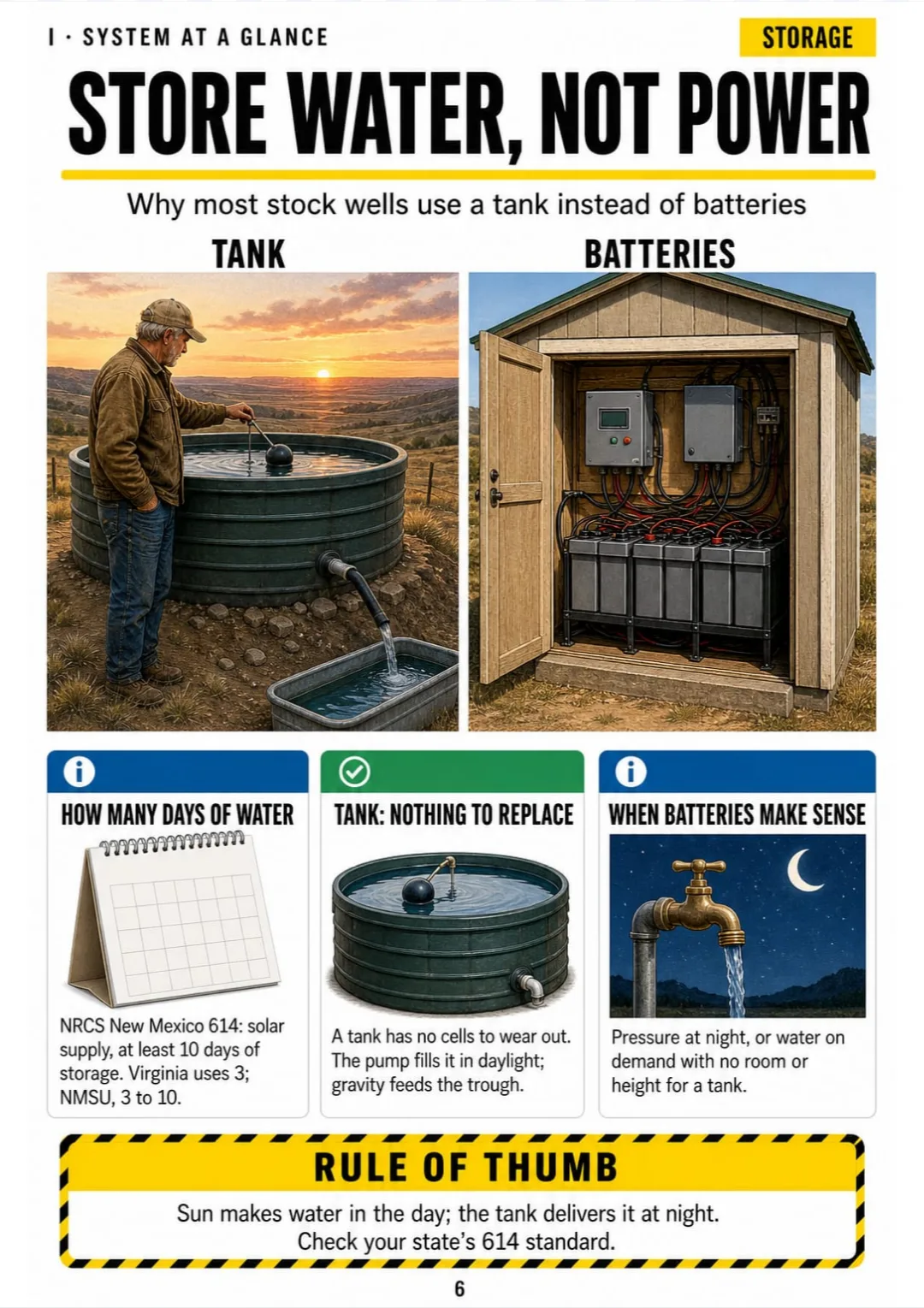
Tank vs batteries: NRCS NM 614 asks for at least 10 days of solar storage.
Beef and horses 10–15 gal/head/day, lactating dairy 22–29, hogs 4, sheep 1–2 (NRCS NM 614, NMSU).
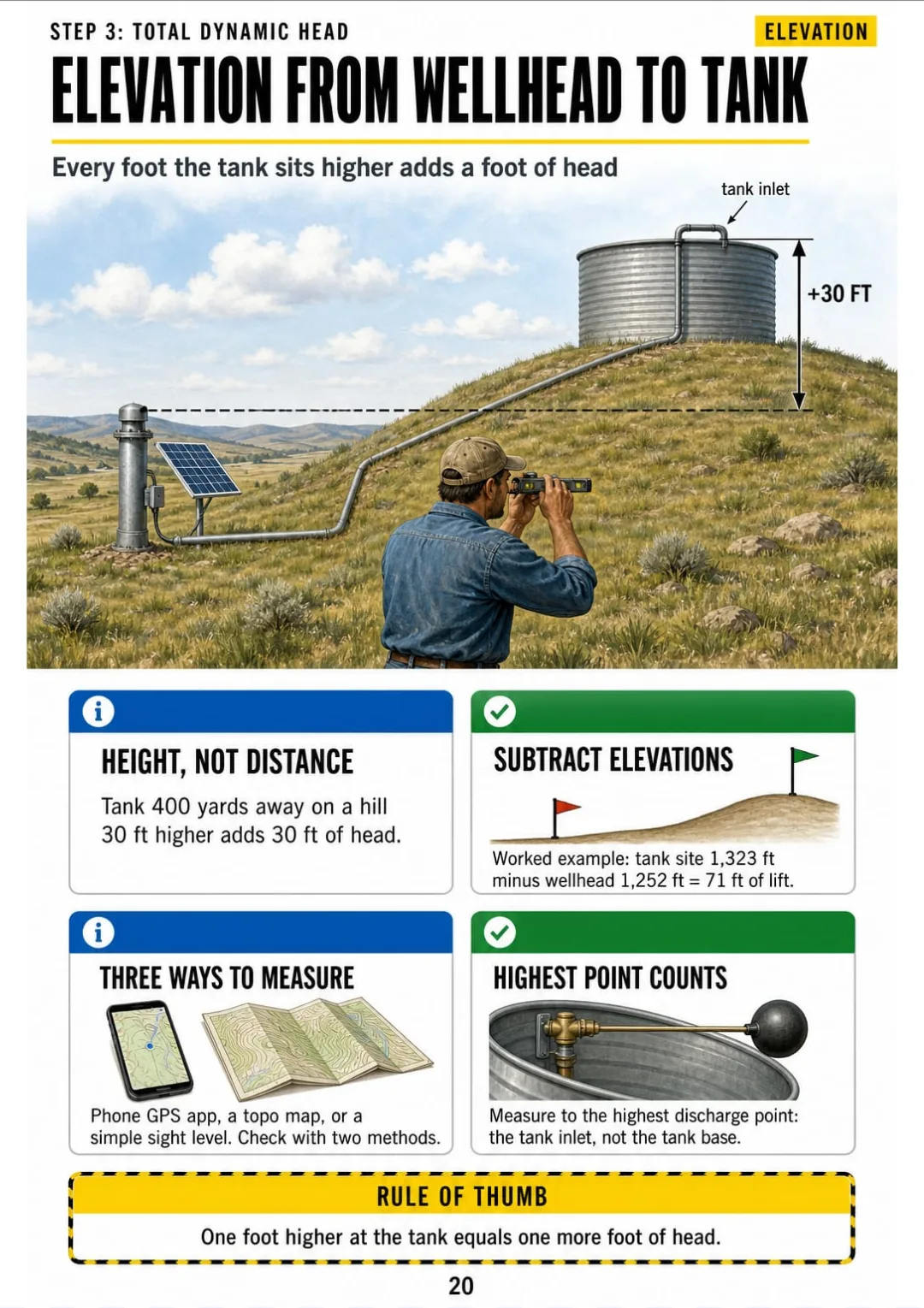
Tank 30 ft above the wellhead = +30 ft of head, even 400 yards away
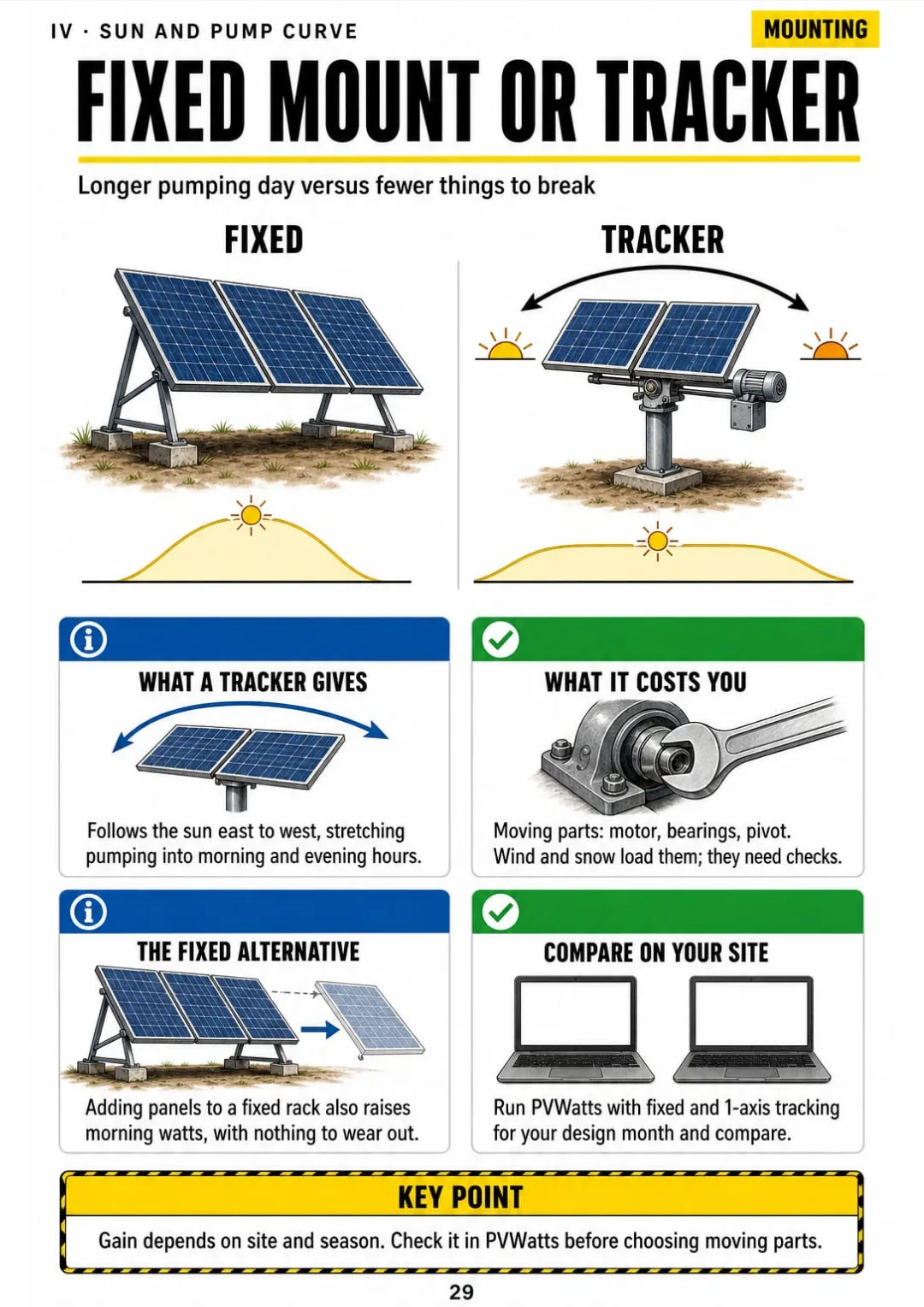
Compare fixed and single-axis tracking in PVWatts for your worst month.
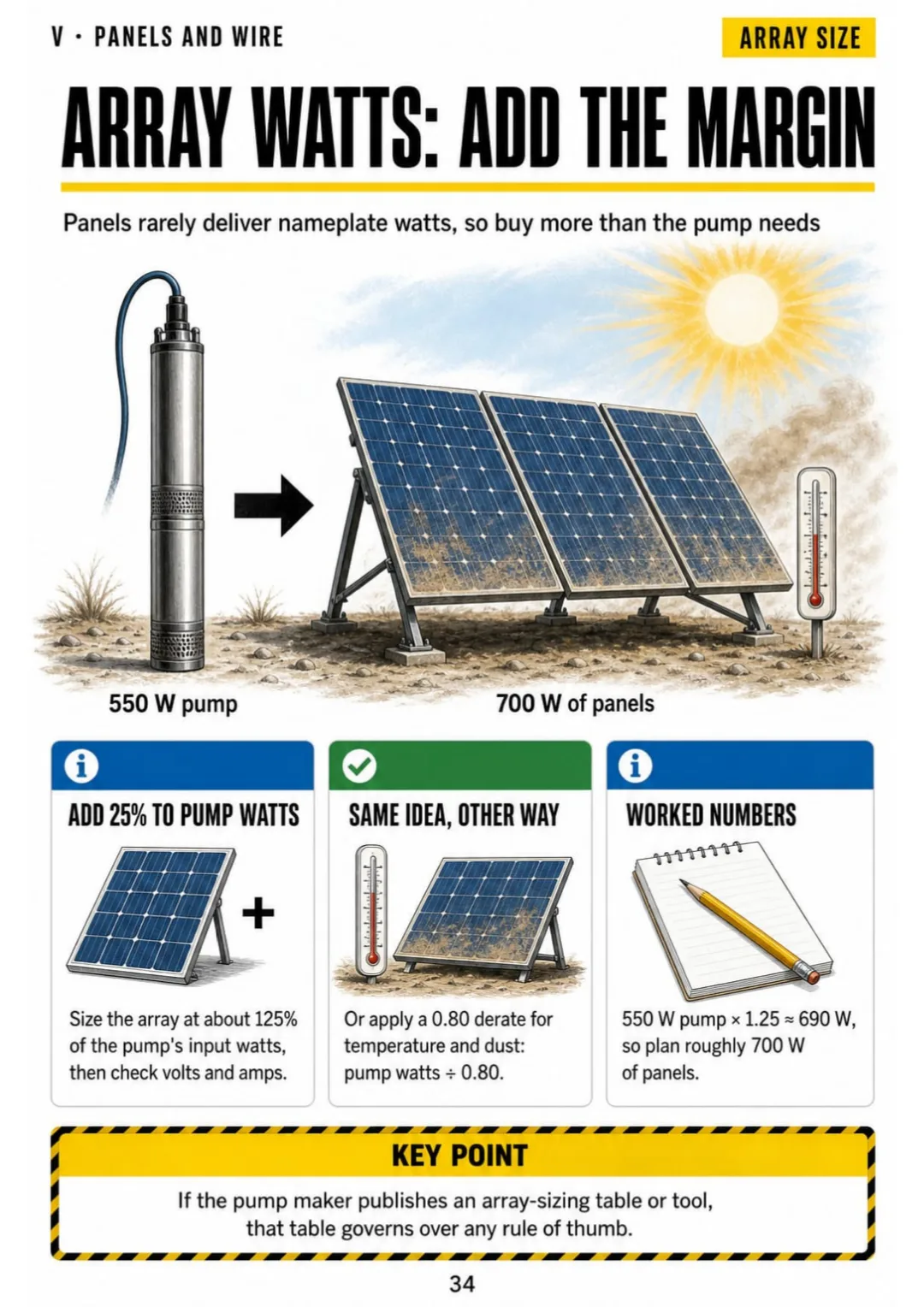
Pump input watts × 125%: a 550 W pump gets about 700 W of panels.
Static level, casing diameter, old setting depth and pitless condition: written down first.
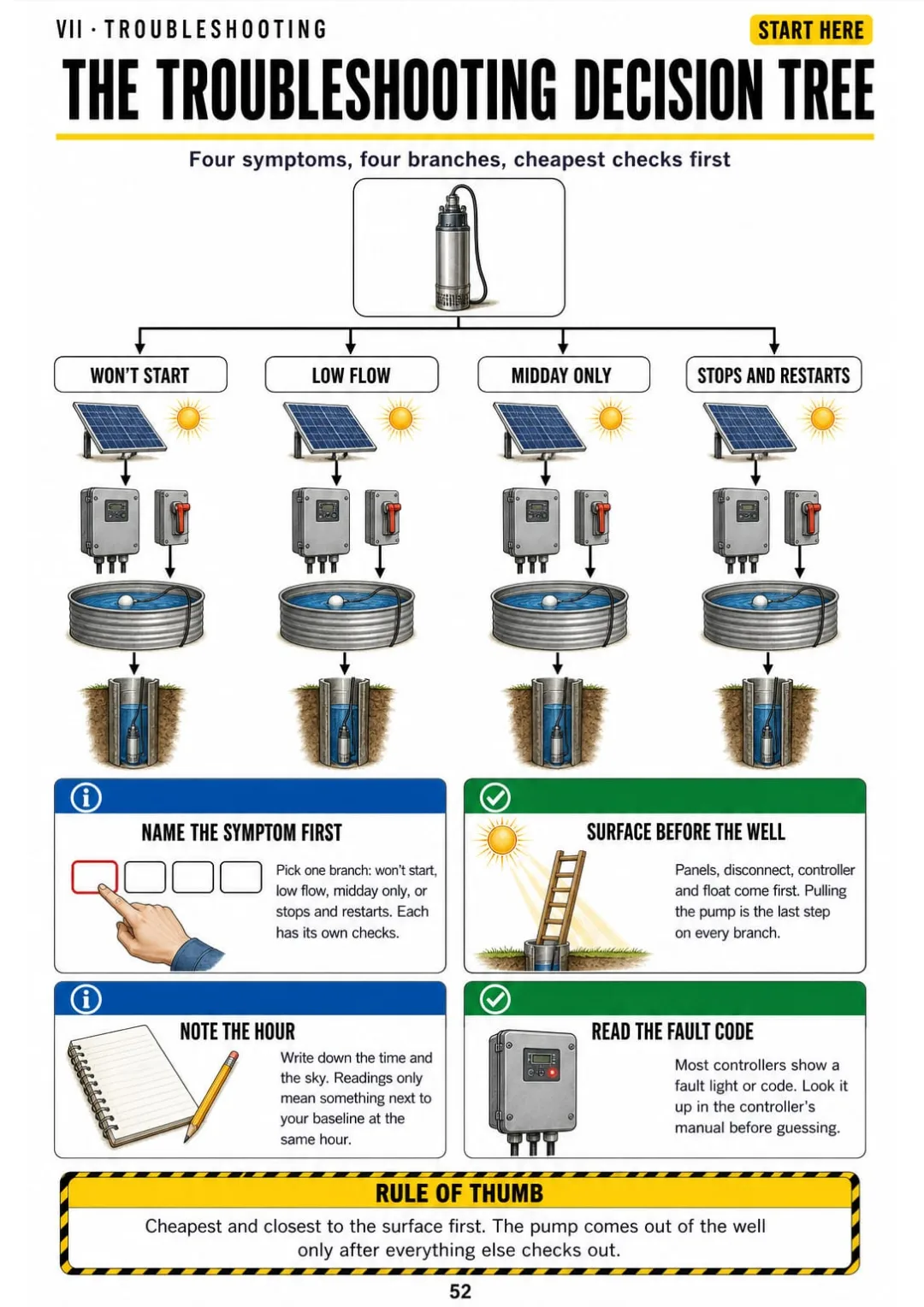
Won't start, low flow, midday only, stops and restarts: each branch starts at the surface.
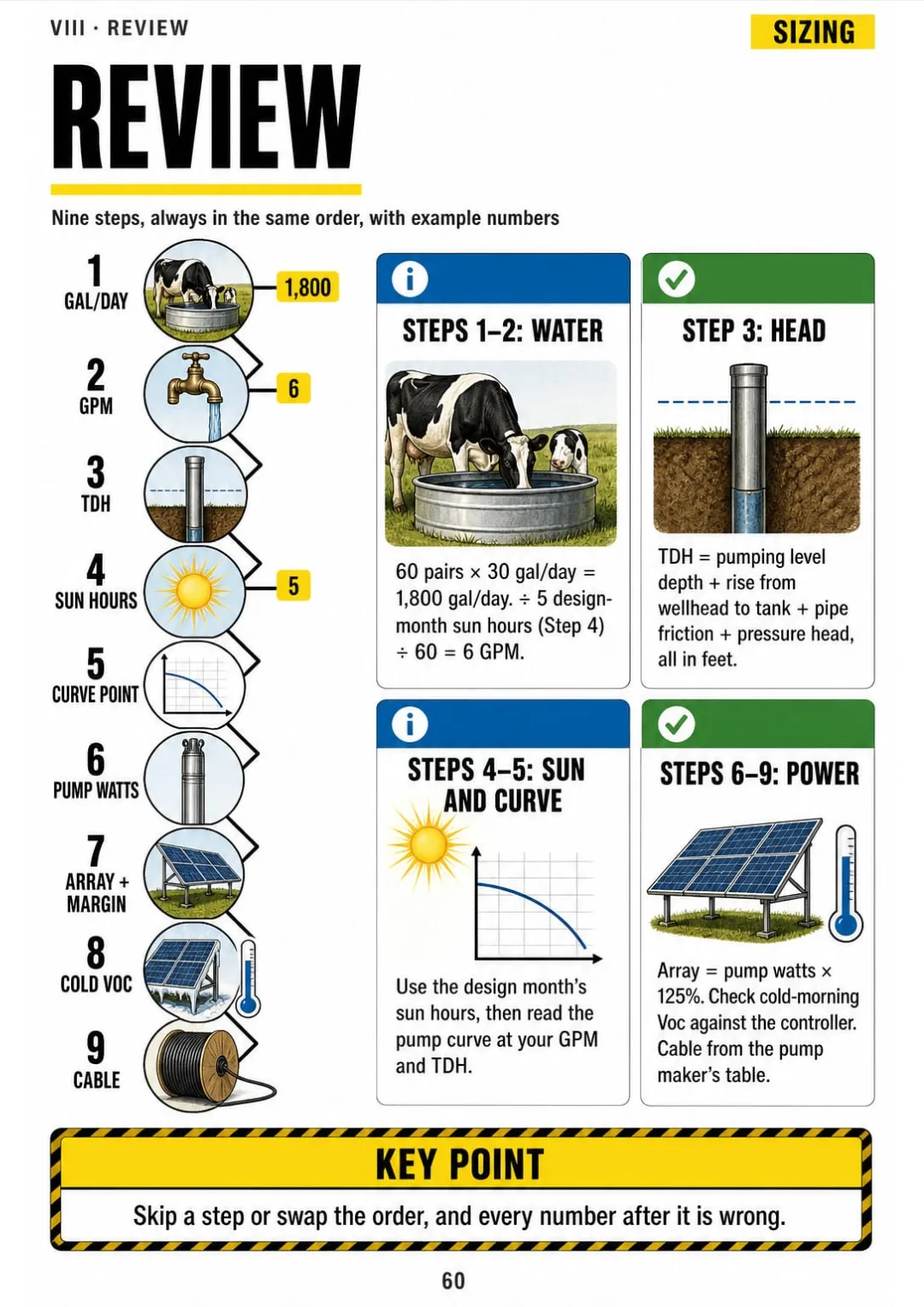
Gallons per day → GPM → TDH → sun hours → curve → watts → margin → cold Voc → cable.

Swipe to see more →

These are real pages from the book. The table of contents is the full one: 8 parts and 60 topics.

The Problem Isn't You. It's How It Was Explained.

You're standing at the wellhead with the driller's log in one hand and a pump spec sheet in the other. The sheet wants a number you don't have yet: total dynamic head.

The manual covers it in three paragraphs: static level, drawdown, elevation, friction, pressure, all in one run of text. It reads fine, and at the end you still don't know what gets added to what.

Tank 30 ft above the wellhead = +30 ft of head, even 400 yards away

In the book, TDH is one drawing: the well cut open, the tank up the hill, and four arrows stacked in feet. Lift from the pumping level, plus rise to the tank, plus friction, plus outlet pressure.

Gallons per head per day, peak sun hours, reading a pump curve, the cold-morning voltage check and the troubleshooting tree work the same way: each one has its own page.

You add up the head yourself, find your point on the curve and pick the pump without going back to the manual.

COMPARE FOR YOURSELF

Same Topic, Two Ways to Learn It

THIS
  • The manual: line after line
  • Water needs explained only in words
  • You show up at the well still unsure
Livestock water requirements vary considerably according to species, class, body weight, stage of production, dry matter intake, ambient temperature and the moisture content of the forage consumed. Mature beef cattle and horses generally consume between 10 and 15 gallons per head per day, whereas lactating dairy cows may require 22 to 29 gallons. Requirements for hogs approximate 4 gallons and for sheep 1 to 2 gallons. Designers are advised to apply peak summer consumption values, rather than annual averages, when determining required system capacity.
FOR THIS
  • Daily water per head in one drawing
  • The gallons in one box
  • You see it and you get it
Beef and horses 10–15 gal/head/day, lactating dairy 22–29, hogs 4, sheep 1–2 (NRCS NM 614, NMSU).
CONTENTS

Take a Look at the 8 Parts and 60 Topics

The system at a glance, water per day, total dynamic head, sun hours and the pump curve, panels and wire, installation, troubleshooting and the field checklists: 64 pages, all illustrated.

IThe System at a Glance · pp. 5-11
  1. The Whole System in One Drawing
  2. Store Water, Not Power
  3. DC Pump or AC Pump on Solar
  4. Helical Rotor or Centrifugal
  5. What the Controller Actually Does
  6. Replacing an Old Windmill
  7. Reading the Driller's Log
IISteps 1–2: Water per Day · pp. 12-17
  1. Gallons per Head per Day
  2. Plan for the Hottest Week
  3. Household Water Off-Grid
  4. Well Yield Sets the Ceiling
  5. From Gallons per Day to Gallons per Minute
  6. Worked Example: 60 Cow-Calf Pairs
IIIStep 3: Total Dynamic Head · pp. 18-25
  1. Total Dynamic Head in One Drawing
  2. Pumping Level, Not Static Level
  3. Elevation from Wellhead to Tank
  4. Friction Loss in the Pipe
  5. Pressure Head: PSI to Feet
  6. Fittings and Valves Add Length
  7. Worked Example: TDH for the Stock Well
  8. Common TDH Mistakes
IVSteps 4–5: Sun Hours and the Pump Curve · pp. 26-33
  1. Peak Sun Hours vs. Daylight Hours
  2. Sun Hours by Region and Month
  3. Tilt and Facing the Array
  4. Fixed Mount or Tracker
  5. How to Read Any Pump Curve
  6. Picking the Right Point on the Curve
  7. Why the Neighbor's Pump Only Runs at Noon
  8. Worked Example: Choosing the Pump
VSteps 6–9: Panels and Wire · pp. 34-41
  1. Array Watts: Add the Margin
  2. Reading a Panel's Label
  3. Series or Parallel
  4. The Cold-Morning Voltage Check
  5. Wire Size Down the Well
  6. The Waterproof Splice
  7. Grounding and Disconnects
  8. Worked Example: Wiring the Array
VIInstallation · pp. 42-51
  1. Before You Pull the Old Pump
  2. Choosing the Drop Pipe
  3. The Safety Rope
  4. Check Valves: Where They Go
  5. Torque Arrestor and Cable Ties
  6. Pitless Adapter and Well Cap
  7. Setting Depth
  8. Sizing the Tank and the Float
  9. Mounting the Array in the Pasture
  10. Startup: Record Your Baseline
VIITroubleshooting · pp. 52-59
  1. The Troubleshooting Decision Tree
  2. Pump Won't Start
  3. Runs But Pumps Little Water
  4. Only Pumps at Midday
  5. Dry-Run Shutdowns
  6. Short Cycling and Float Problems
  7. Taking Volts and Amps Safely
  8. Seasonal Care and Freeze Protection
VIIIReview · pp. 60-64
  1. Step 3: Total Dynamic Head
  2. Install Day Checklist
  3. The Most Frequent Mistakes
  4. What to Check Against Your Documents
  5. Glossary: Words on the Spec Sheet

One Page, One Topic, All Clear

Think of it this way:

It's July, the trough is low by evening, and you need to know if the pump is too small or the array is. First you need the total dynamic head, and you need it right.

You open the TDH page and see the well cut open, the pumping level marked below the static level, the pipe climbing to the tank and four numbers stacked into one total in feet.

Pump input watts × 125%: a 550 W pump gets about 700 W of panels.

Same with gallons per head per day, peak sun hours, the pump curve, array watts with the margin and the cold-morning voltage check: each one on its own page.

Solar Well Pump Illustrated is 8 parts and 60 topics, all drawn, with worked examples in feet and gallons and the field checklists at the end.

What you see drawn, you don't have to memorize.

What's Inside Solar Well Pump Illustrated:

Ipp. 5-11

The System at a Glance

The whole system in one drawing, why you store water instead of power, DC or AC, helical rotor or centrifugal, the controller, replacing a windmill and reading the driller's log.

IIpp. 12-17

Steps 1–2: Water per Day

Gallons per head per day, planning for the hottest week, household water off-grid, well yield as the ceiling, gallons per day to GPM and a worked example with 60 cow-calf pairs.

IIIpp. 18-25

Step 3: Total Dynamic Head

Stop guessing what adds to what: total dynamic head in one drawing, pumping level vs. static level, elevation to the tank, friction loss, PSI to feet, fittings and valves, a worked example and the most frequent mistakes.

IVpp. 26-33

Steps 4–5: Sun Hours and the Pump Curve

Peak sun hours vs. daylight, sun hours by region and month, tilt and facing, fixed mount or tracker, reading any pump curve and why the neighbor's pump only runs at noon.

Vpp. 34-41

Steps 6–9: Panels and Wire

Array watts with the margin, reading a panel label, series or parallel, the cold-morning voltage check, wire size down the well, the waterproof splice, grounding and disconnects.

VIpp. 42-51

Installation

Before you pull the old pump, drop pipe, safety rope, check valves, torque arrestor, pitless adapter and well cap, setting depth, tank and float, mounting the array and startup readings.

VIIpp. 52-59

Troubleshooting

Find the fault from the surface down before you pull anything: the troubleshooting decision tree, pump won't start, low flow, midday only, dry-run shutdowns, short cycling, taking volts and amps safely and seasonal freeze protection.

VIIIpp. 60-64

Review

The sizing order on one page, the install day checklist, the most frequent mistakes, what to check against your documents and a glossary of spec sheet words.

At the end of the book: Worked examples in feet and gallons, a troubleshooting decision tree and field checklists.


Plus: 2 Free Books

Solar Pump Sizing Workbook: 20 Wells to Work Out

BONUS 1: «Solar Pump Sizing Workbook: 20 Wells to Work Out»

Value on its own: US$ 17.90

Twenty practice wells with real numbers (herd size, static level, drawdown, sun hours) so you can run the sizing steps yourself and check your answer on the next page.

Solar Pump Field Cards

BONUS 2: «Solar Pump Field Cards»

Value on its own: US$ 14.90

Printable quick cards with the sizing order, wiring checks and the most common install mistakes, to keep in the truck and glance at on site.

Solar Well Pump Illustrated with 2 Free Books

  • Solar Well Pump Illustrated: 64 illustrated pagesUS$ 63
  • BONUS 1: Solar Pump Sizing Workbook: 20 Wells to Work OutUS$ 17.90
  • BONUS 2: Solar Pump Field CardsUS$ 14.90
  • High-resolution PDF to printIncluded
Total value US$ 95.80
YOUR PRICE:
US$ 27
You save US$ 68.80
YES, I WANT SOLAR WELL PUMP ILLUSTRATED FOR US$ 27

📄 This is a digital PDF book sent to your email: nothing is printed or shipped.

Secure purchaseEncrypted payment30-day guarantee

PDF by email: We email you Solar Well Pump Illustrated as a PDF, together with the two free books. It's a single payment: no installments, no extra charges.

Who This Book Is For

You're Planning Your First Solar Well

You're Planning Your First Solar Well

You get the sizing in five steps, always in the same order, so you work out the pump and the panels from your own herd and your own well before you buy anything.

Install Day Is Coming

Install Day Is Coming

You know what to write down before the old pump or windmill comes out, where the check valves go and what readings to record at startup. The field cards ride in the truck.

You Already Set Pumps for a Living

You Already Set Pumps for a Living

Same wells, new parts: array voltage, the controller and helical rotor curves, each on one drawn page, plus a troubleshooting tree that starts at the surface.

Everything You Get Today

US$ 95.80US$ 27
YES, I WANT SOLAR WELL PUMP ILLUSTRATED FOR US$ 27

📄 This is a digital PDF book sent to your email: nothing is printed or shipped.

30DAYS
GUARANTEE

30-Day Guarantee

Try Solar Well Pump Illustrated for 30 days, bonus books included.

We refund everything if the file won't open, if the book isn't what you see here, if you were charged twice or if the email doesn't arrive. Just email us.

You pay once. No subscriptions.

Frequently Asked Questions

Is it for me if I've never installed a pump, or if I already set 230 V pumps?

Yes to both. It starts from the whole system in one drawing and goes step by step, and the installer finds the solar-specific parts (array, controller, cold-morning voltage, curves) on their own pages.

Where does the content come from?

From the National Electrical Code Article 690 on solar PV, NREL solar resource data for sun hours by region and month across the U.S., USDA NRCS standards for livestock watering and the way manufacturers' spec sheets are laid out. Everything is in feet, gallons, PSI and AWG. Each page marks what to check against the current code, your driller's log and the pump's spec sheet.

Is this official material?

No. It's an independent illustrated guide. It isn't published or endorsed by any agency, code body or manufacturer, and it doesn't push any brand: it teaches you to read any pump curve.

Does it replace training or a licensed electrician?

No. It helps you understand, size and plan the job. Where your local law requires it, the electrical connection is done by a licensed electrician or well contractor.

Are the practice wells in the workbook real wells?

No. The 20 wells were written for this book with realistic numbers (herd size, static level, drawdown, sun hours) so you can run the steps and check your answer on the next page.

When and how do I get it?

As a PDF by email, sent to the address you enter at checkout.

Do I have to pay every month?

No. It's a one-time payment. No subscription.

Can I have it on paper?

Yes. The PDF is made to print, on your home printer or at a print shop, so you can take it to the well.

How does the refund work?

You have 30 days. We refund everything if the file won't open, if the book isn't what you see on this page, if you were charged twice or if the email doesn't arrive: just email us.

Before You Close This Page

No more rereading spec sheets that don't stick.

Total dynamic head: you see it drawn and you've got it.

You get to the well knowing where everything goes.

Drawings make studying faster.

The book is right below.

One-time payment: US$ 27 · Guarantee: 30 days · PDF by email

YES, I WANT SOLAR WELL PUMP ILLUSTRATED FOR US$ 27

📄 This is a digital PDF book sent to your email: nothing is printed or shipped.